
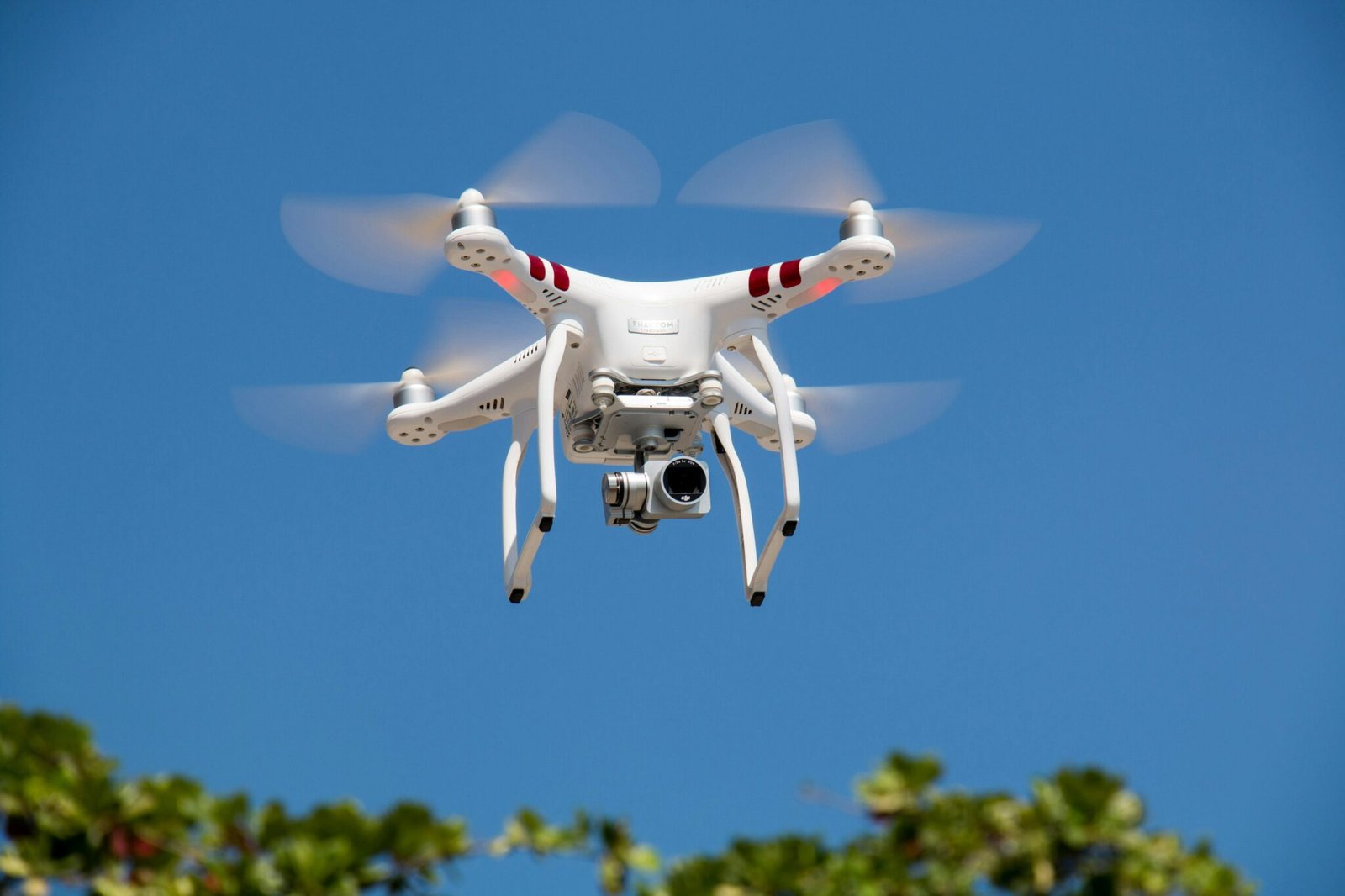




Like a tiny moth skimming a lamp, a new four-wing drone quietly holds position around a moving light source. The craft demonstrates hovering with a natural feedback loop, not a reliance on complex AI or GPS signals. This approach aims to unlock stable, minimalism-driven flight for micro-drones used in inspection, search tasks, and covert sensing. By mimicking the way insects lock onto a target and compensate for wind, the designers show that simple, real-time corrections can produce surprisingly steady hover.
Recent Trends
- Biomimicry drives compact, efficient drones
- Extremum-seeking control gains traction in robotics
- Light-tracking hover could aid autonomous sensing
At the heart of the project is extremum-seeking feedback, a math-based method that allows a system to optimize its performance without a preset model. In this case, the target is light. The UC team, led by Assistant Professor Sameh Eisa, argues that hovering insects operate with a similar principle: constant, tiny adjustments to stay aligned with a moving cue. By treating hover as a real-time optimization problem, the drone can maintain position without heavy computation or AI-driven planning.
Instead of relying on GPS or external navigation, the drone uses its own performance signals to stay on course. The four wings flap independently, enabling roll, pitch, and yaw control. To observers, the motion appears as a rapid blur, reminiscent of a hummingbird in flight. The effect is not to chase precision through a complex model, but to let the system continually refine its stance based on feedback from the environment.
Researchers in Eisa’s Modeling, Dynamics and Control Lab built the craft from wire and fabric, a deliberately lightweight platform designed to test natural feedback in a practical frame. In demonstrations within a protected flight lab, the drone lifted off and hovered, even as researchers introduced mild disturbances meant to mimic gusts. The team notes that the occasional wobble during hover is not a flaw; it is a tool the drone uses to gauge performance and perform micro-adjustments for direction and stability. The result is a hovering behavior that remains resilient even when the light source moves quickly.
Elgohary and UC graduate student Rohan Palanikumar emphasize that their goal is not to outpace AI systems but to show that a robust, model-free loop can handle a surprising range of environments. A key quote from the study frames the point: “Our simulations show that extremum-seeking control can naturally reproduce the stable hovering behavior seen in insects, without AI or complex models.” The researchers describe the principle as a simple, real-time feedback loop that works with minimal computational burden.
For industry readers, the implication is clear: tiny, power-efficient drones could perform accurate light-tracking tasks without heavy onboard processors. This could lower cost and extend flight times for reconnaissance, wildlife monitoring, or infrastructure inspections in challenging environments where GPS is unreliable. It could also inform the design of next-generation micro-drones that operate in cluttered spaces or indoors where GPS signals fade and AI computation becomes a limiting factor.
From a policy and standards perspective, model-free control approaches may shift how regulators think about reliability and safety testing. Without a fixed navigation model, testing focuses more on real-world robustness and repeatability under varied lighting and airflow. This aligns with broader moves toward simpler, more transparent control strategies that engineers can validate through repeatable lab experiments rather than rely solely on black-box AI performance.
Looking ahead, the work signals a broader trend: the fusion of biomimicry with lightweight control theory to deliver practical, scalable drones. If extremum-seeking feedback can generalize beyond light-tracking, we could see a new class of insects-inspired, ultra-light platforms that excel in hovering, maneuverability, and energy efficiency. The study, published in Physical Review E, adds to a growing body of evidence that nature-inspired engineering can unlock robust behavior with surprisingly lean software and hardware requirements. For defense planners and civilian operators alike, the message is unmistakable: simplicity can be a strategic advantage in aerial robotics.
In summary, the mothlike drone demonstrates that natural feedback loops, grounded in well-understood control theory, can achieve stable hover without AI. The design is not about mimicking moths perfectly; it’s about translating a core principle of insect flight into a practical robotics solution. As researchers refine these concepts, the path to compact, efficient, and reliable micro-drones for inspection, mapping, and surveillance looks more promising than ever. For practitioners, the takeaway is clear: start with the simplest robust control, and let the environment provide the feedback you need to stay aloft.
For readers seeking a concise takeaway: a mothlike drone can hover around a moving light using extremum-seeking feedback, illustrating how biology-inspired design and model-free control can deliver stable flight without traditional AI. This could shape future drone architectures and testing standards as the industry embraces more lightweight, resilient platforms.
Conclusion
The UC effort showcases a compelling blend of biology-inspired design and practical control theory. By decoupling hover stability from AI, the project highlights a scalable path for micro-drones across civil and commercial uses. As researchers push the boundaries of biomimicry and model-free control, expect more demonstrations that pair elegant simplicity with real-world reliability.

















